A boom lift raises people and their tools so they can work at height. A telehandler lifts and places material, such as pallets of block, roofing bundles or lumber. If the job is someone working up high, rent a boom lift or scissor lift. If the job is getting heavy material up onto a roof, a second floor or across a rough job site, rent a telehandler. Plenty of projects use both.
TRS Equipment Rental has rented lifts and material handling equipment in Tucson since 1987. Our aerial lift lineup includes the Genie TZ-34/20 towable electric boom lift, the JLG 400S dual fuel boom lift with a 40-foot boom, Genie GS-1930 and GS-2632 electric scissor lifts and the Genie GR20 vertical lift. On the telehandler side, we carry the JCB 505-20TC with a 20-foot reach and 5,000-pound capacity and the Caterpillar TH460B with a 44-foot reach, along with a Genie SLC-24 material lift and a drywall lift.
What is the difference between a boom lift and a telehandler?
The simplest way to tell them apart is to ask what’s going up. A boom lift has a platform, often called a basket, built to hold workers. Controls are in the basket, so the operator positions themselves exactly where the work is.
A telehandler, short for telescopic handler, looks a bit like a forklift with a long telescoping boom. It’s built to carry loads on forks or other attachments, with the operator driving from the cab on the ground. It can reach up and out in ways a standard forklift can’t, which is why it’s a staple on construction sites.
They may look like they overlap, but they’re designed and rated for different jobs, and using one for the other’s purpose is where people get hurt.
When should you rent a boom lift?
Rent a boom lift when someone needs to work at height and reach up and over something. Typical jobs include exterior painting and stucco repair, installing signs, lighting or security cameras, gutter and fascia work, and reaching over landscaping, fences or obstacles that would block a straight vertical lift.
The Genie TZ-34/20 offers up to 34 feet of working height and 20 feet of outreach. It’s electric, so it runs quietly without exhaust, and it tows behind a truck, which makes it handy for contractors moving between several sites. The JLG 400S has a 40-foot boom and runs on gasoline or propane, a good fit for taller outdoor work.
When is a scissor lift a better choice than a boom lift?
If the work is straight up with nothing in the way, a scissor lift is often the simpler and more stable option. Scissor lifts have a larger platform than a boom lift basket, which gives workers more room for tools and materials when they’re doing ceiling work, overhead electrical or drywall finishing.
The Genie GS-1930 reaches a 19-foot platform height and the GS-2632 reaches 26 feet. Both are electric and well suited to indoor work on flat, solid floors. The Genie GR20 is a narrow vertical lift that fits through standard doorways, which makes it useful for tenant improvements and warehouse maintenance.
When should you rent a telehandler?
Rent a telehandler when you need to move heavy material and place it somewhere a person can’t easily carry it. Common uses include lifting pallets of block, pavers or roofing onto a roof or upper floor, unloading delivery trucks on sites without a loading dock, moving material across uneven ground, and staging framing lumber close to where crews are working.
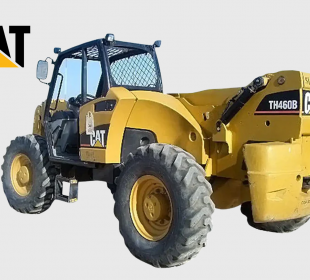
The JCB 505-20TC is a compact telehandler with a 20-foot reach and 5,000-pound lift capacity, which suits residential construction and tighter sites. The Caterpillar TH460B reaches 44 feet for taller buildings and heavier commercial work.
Every telehandler has a load chart, and it matters. Capacity drops as the boom extends and rises, so a machine that can lift 5,000 pounds close in may lift far less at full reach. Know the weight of your load and where it needs to go before you pick a machine.
For lighter jobs indoors, the Genie SLC-24 material lift raises loads up to 24 feet without needing a telehandler, and the drywall lift holds 4×8 sheets at ceiling height so one person can hang them.
Can a telehandler be used to lift people?
Only with a work platform attachment that the telehandler’s manufacturer has approved for that specific model, used according to the operator’s manual and load chart. Workers should never ride on the forks, a pallet or a bucket. If your crew needs to work at height, a boom lift or scissor lift is usually the safer and simpler choice. Ask the TRS team before you plan around using a telehandler for personnel.
How do boom lifts, scissor lifts and telehandlers compare?
| Feature | Boom lift | Scissor lift | Telehandler |
| Main purpose | Lifting workers up and out | Lifting workers straight up | Lifting and placing material |
| Where the operator stands | In the basket | On the platform | In the ground-level cab |
| Reach over obstacles | Yes | No | Yes, for loads |
| Best surface | Varies by model | Flat and firm | Job site ground |
| TRS models | Genie TZ-34/20, JLG 400S | Genie GS-1930, GS-2632, GR20 | JCB 505-20TC, Cat TH460B |
| Max height or reach at TRS | 40-foot boom | 26-foot platform | 44-foot reach |
What training and safety rules apply to lifts and telehandlers?
OSHA requires operators of aerial lifts and telehandlers to be trained before using them on a job site, and employers are responsible for making sure that happens. TRS provides operator guidance at pickup or delivery, but it doesn’t replace formal training for your crew.
In a boom lift, workers need a body harness with a lanyard attached to the boom or basket. Stay at least 10 feet away from overhead power lines, and more for higher voltages. Before raising any lift, check the ground. Soft soil, recent backfill and slopes can make a machine unstable.
Tucson’s weather adds a few considerations. Afternoon wind gusts are common in spring and during monsoon season, and every lift has a maximum wind rating in its manual. Some scissor lifts are rated for indoor use only. Metal platforms and controls get very hot in summer sun, so morning work is easier on both crews and machines. Our jobsite safety guide covers more of the basics.
What should you ask before renting a lift?
A few questions will point you to the right machine:
- Are you lifting people, material or both?
- How high do you need to reach, and how far out?
- Is the work indoors or outdoors, and what is the ground like?
- How heavy is the load if you are moving material?
- Will you tow the machine yourself or need delivery?
Transport is worth thinking about early. The TZ-34/20 is designed to tow, while a telehandler like the JCB 505-20TC weighs around 14,000 pounds and usually needs delivery.
How do you rent a boom lift or telehandler from TRS?
Call 520-744-6333 or request a quote online. Tell the team what you’re lifting, how high it needs to go and what the site looks like, and they’ll help you choose the right lift. TRS has no deposit and no reservation fees, and delivery is available throughout Tucson and rural Southern Arizona.
TRS Equipment Rental is at 7255 N. Camino de Oeste near Ina Road and I-10, open Monday through Friday from 6:30 AM to 3:00 PM. You can also check availability through the online rental portal. Working into the evening? A light tower rental keeps the site lit.
Frequently Asked Questions
Is a cherry picker the same as a boom lift?
Yes. Cherry picker is a common nickname for a boom lift, especially the articulating type with a basket at the end of the arm.
What is the difference between a telehandler and a forklift?
A forklift lifts straight up and works best on smooth, flat surfaces like warehouse floors. A telehandler has a telescoping boom that reaches up and forward, and it’s built for job site conditions.
Do I need training to operate a boom lift?
Yes. OSHA requires trained operators for aerial lifts on job sites. Homeowners aren’t covered by those workplace rules, but learning the controls, tie-off requirements and safety checks before going up is just as important.
Can I tow a boom lift myself?
The Genie TZ-34/20 is a towable boom lift, so you can tow it with a properly equipped vehicle. Ask TRS about hitch and vehicle requirements before pickup, or schedule delivery instead.
How high can a TRS rental lift reach?
The JLG 400S boom lift has a 40-foot boom, and the Caterpillar TH460B telehandler reaches 44 feet for material placement. For indoor work, the Genie GS-2632 scissor lift reaches a 26-foot platform height.